

Harvest Right | Spider for Lovejoy coupling - Oil Free Scroll Vacuum Pump Part
Harvest Right
Item:
- Regular price
- $34.00
- Regular price
- Sale price
- $34.00
- Unit price
- per
Estimated Arrival: Between Aug 29 and Sep 19.
Couldn't load pickup availability
Free Shipping to the 48 Contiguous States including Lift Gate Service
Free Shipping to the 48 Contiguous States including Lift Gate Service
Our Shipping Policy Page has details of our Free Shipping to the 48 contiguous states with Lift gate Service included, as well as other things you should know.
No Sales Tax (except in GA)
No Sales Tax (except in GA)
Price Match
Price Match
We will match a lower price. Check out our Price Match Policy
Before You Purchase
Before You Purchase
Before you Purchase has several things to consider before ordering a large greenhouse or building. You should also review our Refund Policy.
This Deal Ends In:
 PRODUCT DESCRIPTION
The Harvest Right Oil Free Scroll Vacuum Pump assembly consists of two main parts - the motor and the pump. When the elastomeric spider insert in the Lovejoy (jaw) coupling between the motor and the pump degrades or fails, the pump loses the mechanical damping and alignment buffer between the motor and the scroll pump head.
Here are some of the symptoms that indicate that you may need to replace the spider. Note that the spider is not included in the pump rebuild kit and must be ordered separately.
Acoustic Changes
-
Metallic clacking or chattering: A distinct rhythmic rattling, clicking, or knocking sound, most pronounced during initial startup, shutdown, or as the pump reaches deeper vacuum levels (higher mechanical resistance).
-
Metal-on-metal grinding: As the rubber or urethane cushion disintegrates, the intermeshed metal jaws of the motor hub and pump shaft hub make direct contact.
Mechanical Play and Physical Debris
-
Rotational backlash (slop): With the unit unplugged, rotating the motor cooling fan or shaft back and forth by hand reveals noticeable loose play before the pump mechanism engages.
-
Elastomer dust or shavings: Black, red, or yellow rubber/urethane powder, flakes, or shredded chunks accumulating under or around the coupling adapter housing vents.
Vibration and Thermal Issues
-
Elevated housing vibration: Increased operational vibration through the pump chassis, mounting feet, and connected vacuum line due to torque misalignment.
-
Excessive heat at the coupling housing: Friction from metal-on-metal jaw contact or compressed/deformed elastomer generates localized heat between the motor and pump head.
Operational and Electrical Symptoms
-
Sluggish or erratic pull-down: Inefficient torque transfer or cyclical binding can prevent the scroll mechanism from sustaining continuous RPM, leading to slower mTorr drop rates.
- Motor hard-starting or thermal tripping: Jammed fragments of a destroyed spider wedging inside the coupling jaws can create enough rotational resistance to trigger the motor’s thermal overload switch or breaker.
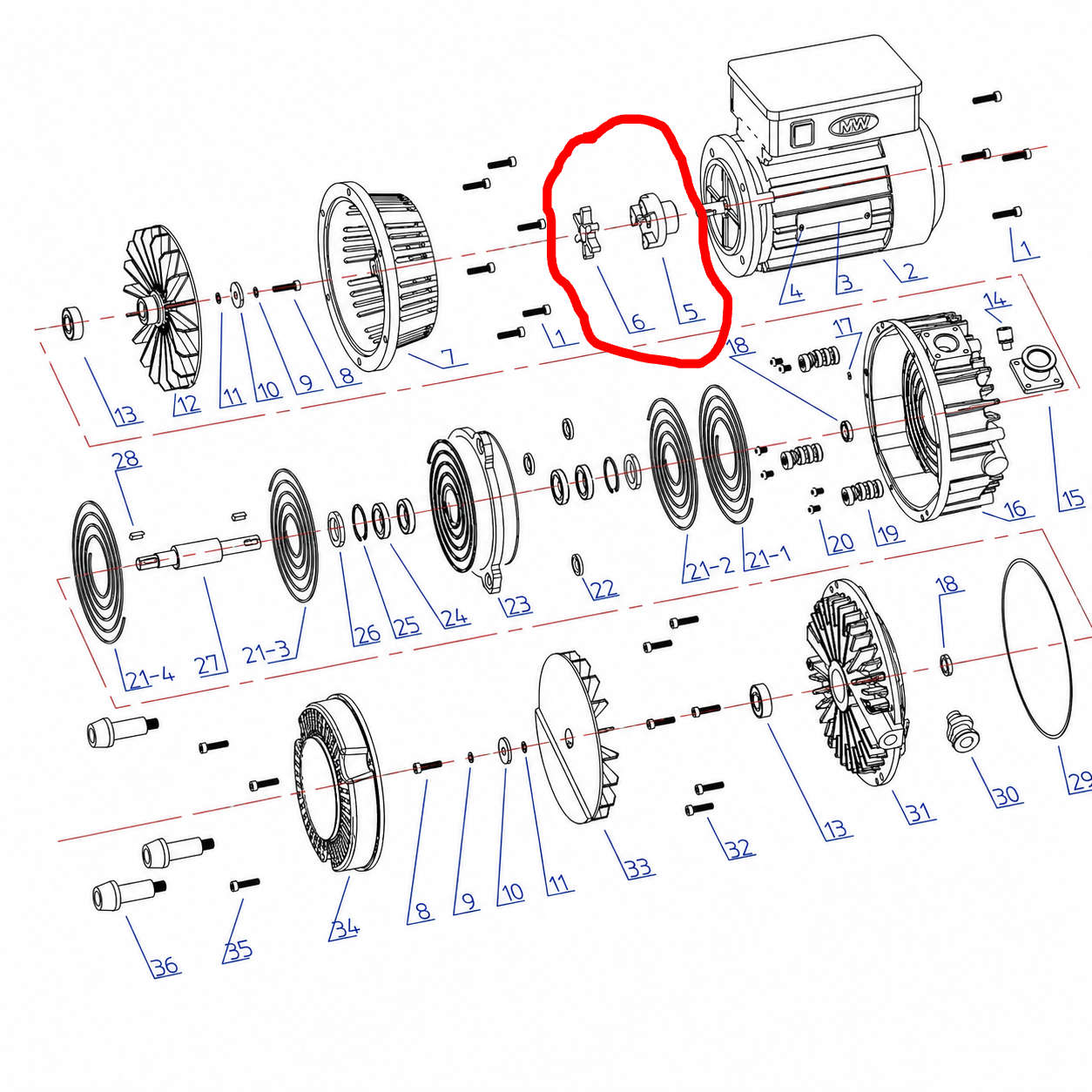
There are different sizes of coupling hub and spider in different models and ages of pumps. You should measure the exact outside diameter of the coupling hub to determine which size spider you need. The most modern pump version has a 1.75" o.d. coupling hub. This exploded diagram of the pump assembly shows the coupling hub and spider with a red outline.
 Some of the older versions of the pump use a coupling which is significantly smaller, with a hub o.d. of 1.36".
Why This Greenhouse Is Worth Buying From Us
-
 Google Rated Top Quality Store
-
 100% FREE Shipping
-
 No Sales Tax
-
 Financing Available
-
 Price Match
-
 Live Customer Service
-
 American Owned Business
Let customers speak for us
Absolutely great company! They put in the work to make sure I had the right parts ordered. They also got everything shipped fast. Would recommend 💯

The kit had everything in it to rebuild the pump. Everything fit great. Would purchase this kit again.
Also, product was delivered in a reasonably timely manner.

I bought a 20x 9 Ft aluminum lean-to for my wife’s flowers. The mygreenhousestore folks answered all of my pre- order questions very well and their technical support was excellent for the few questions I had during construction. You have to acclimate yourself to the instructions and the well labeled parts,, but the construction goes well.
My wife loves it!!

The customer service, experience and care from both mygreenhousestore.com and from Exaco have been nothing short of an absolute joy! This cabin is adorable, well made and a good size for my needs. Though I have no intention of using it as a grill cabin, but rather as a work/office space for clients, yoga classes and small workshops/retreats, it could also easily function as a guest cabin. The natural wood is gorgeous. The price is fair. The craftsmanship and attention to detail are refreshing in a world so often using mass produced items.

It was very difficult to get these parts from Harvest Right without going through some 3rd party service that wanted to charge me a fee over the phone to diagnose what I already knew. So thank you for having these. It helped greatly!!
Love this Exact 2-N-1 Kitchen Compost Bucket! Perfect size, very tasteful looking, and very easy to use!

Just finished my Victorian 36 greenhouse. It was quite a challenge doing it mostly by myself but the engineering and fit was amazing. Everything we needed came with it and was well organized. Hope to have it filled up soon. I will say though, the directions and construction guide could use some real help. It was way too vague and left out many steps that would have been very helpful down the line. A step by step video would be great. Overall very happy with it!

Exactly what I need pretty quick shipping

I was looking for a vinyl/plastic shed rather than metal or wood for the side of my garage. This shed works perfectly, but I'd be cautious in a windy/wet environment unless you apply extra silicone sealant and properly anchor it.
Shed assembly time was about 6 hours by myself, and all of the instructions were easy to follow. There is also a video online that you can use as an assembly reference, but it doesn't replace the step-by-step instructions.
I would buy it again.

Works well, we have ran about 20 batches through it so far and it does an excellent job.

This is the standard roof vent opener for my greenhouse. I needed to replace both of mine after several years of use.

I still havnt received it, been shipping keeps getting delayed.
I had a great experience with Rep. Steve. He made sure to listen to my needs and helped make my experience easy. The greenhouse is amazing! I would suggest purchasing screens and or shading because it can get really hot inside even with the windows opening. I plan to use mines as a sunroom/outdoor area so not quite finish with everything. However I have attached Pic of the build.

Seller was very courteous and attentive to my needs. Materials arrived quickly. I would order again.

Questions & Answers
Have a Question?
Be the first to ask a question about this.